Wizard What s Your Wisdom Save Again
Spell Save DC 5e
This is how y'all calculate a grapheme's spell save DC in DnD 5e:
Spell save DC = viii + spellcasting ability modifier + proficiency bonus
What'southward my spellcasting power modifier?
What's my proficiency bonus?
Answers to the other most common spell salve DC questions
Relevent rule text from the Thespian's Handbook:
Many spells specify that a target can make a saving throw to avoid some or all of a spell's effects. The spell specifies the power that the target uses for the salve and what happens on a success or failure.
(Player's Handbook, pg. 205)
"Whatever special modifiers" refers to some magic items, which can exist institute below.
Spell Relieve DC 5e
Spell save DC tin can be a tricky concept for newcomers to Dungeons and Dragons to wrap their heads around. After all, agreement this i mechanic requires a basic understanding of four other mechanics: saving throws, difficulty classes, proficiency bonuses, and spellcasting abilities.
In do, the spell relieve DC mechanic is a whole lot simpler than it seems at fist glance. When someone's targeted by a spell, it'southward only the static number they take to curlicue against to partially or fully avoid the spell's negative furnishings.
Allow's go through each piece of the spell salve DC puzzle, one step at a time.
Spellcasting Ability by Course in DnD 5e
Each spellcaster class in DnD 5e has a spellcasting ability — Charisma, Intelligence, or Wisdom:
| Class | Spellcasting Ability |
|---|---|
| Bard | Charisma |
| Paladin | Charisma |
| Sorcerer | Charisma |
| Warlock | Charisma |
| Artificer | Intelligence |
| Sorcerer | Intelligence |
| Fighter (Eldritch Knight) | Intelligence |
| Rogue (Arcane Trickster) | Intelligence |
| Cleric | Wisdom |
| Druid | Wisdom |
| Ranger | Wisdom |
| Monk (Manner of the 4 Elements) | Wisdom |
After you figure out which spellcasting ability modifier to apply for your class, look at what your modifier is for that ability on your character sheet:
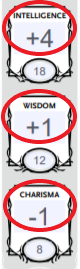
Note that your power modifier is the + or – number that ranges from -5 to +five — it is not your ability score, which ranges from ane to twenty.
If a non-spellcaster somehow casts a spell that forces a saving throw, their spellcasting ability modifier is +0.
Remember: A grapheme'due south spell save DC is eight + their proficiency bonus + their spellcasting ability modifier. The listing above tells you lot which power to refer to depending on what spellcaster course you're playing.
Proficiency Bonus past Level in DnD 5e
| Level Range | Proficiency Bonus |
|---|---|
| i-4 | +ii |
| v-8 | +3 |
| nine-12 | +4 |
| 13-16 | +5 |
| 17-20 | +6 |
How Practice I Increase My Spell Salvage DC in 5e?
To increase your spell save DC in 5e, increase your spellcasting ability modifier and proficiency bonus — both of which are accomplished by leveling up your character.
-
Increase your spellcasting ability modifier. You spellcasting abilitity is class-dependent, but every grade gets the Ability Score Comeback feature at levels 4, viii, 12, 16, and 19. Fighters become additional ASIs at levels half-dozen and 14, and Rogues get an additional ASI at level x.
This feature allows you to increase an ability score by +2, or 2 ability scores by +1 (or pick up a feat, but that's not what we're talking most here). For every two points yous put into an power score, your ability modifier increases by 1. Here'due south a breakup of the positive bonuses that are normally doable:
-
Increase your proficiency bonus. This one's more than straightforward — your proficiency bonus starts at +2 and increases by +1 at levels five, ix, xiii, and 17. Your proficiency bonus caps out at +6.
Here'due south a link to the proficiency bonus table from higher up.
| Power Score | Ability Modifier |
|---|---|
| x-xi | +0 |
| 12-13 | +i |
| 14-15 | +2 |
| 16-17 | +3 |
| eighteen-19 | +4 |
| xx-21 | +v |
Nether normal circumstances, 20 is an power score'due south maximum value, so your spellcasting ability modifier caps out at +5 (PHB 173).
Then one time a player reaches level 17 with a spellcasting power score of 20, they accept a spell save DC of 19:
Spell Save DC = 8 + spellcasting ability modifier + proficiency bonus
nineteen = 8 + 5 + 6
If you want to get a higher spell save DC, y'all'll need to turn to magic items…
What Magic Items Increment Spell Relieve DC in 5e?
The Dungeon Main'south Guide simply contains ii magic items that directly impact your spell save DC, and four items that indirectly do so by boosting your maximum spellcasting ability score. Tasha's Cauldron of Everything introduced an boosted seven magic items that straight buff a histrion's spell save DC.
Hither are all xiii of the official magic items in DnD 5e that tin can heave your spell salve DC across xix:
Tasha's Cauldron of Everyting
| Magic Item | Bear on | Class Restriction |
|---|---|---|
| Deck of Many Things: Star Card | +2 ASI, up to 24 (+1 spell relieve DC) | – |
| Tome of Leadership and Influence | +ii Charisma, by the maximum of 20 (+1 spell salve DC) | Will only help Bards, Paladins, and Sorcerers, and Warlocks |
| Tome of Clear Thought | +2 Intelligence, past the maximum of twenty (+i spell salve DC) | Will merely help Artificers, Wizards, EK Fighters, and AT Rogues |
| Tome of Understanding | +2 Wisdom, past the maximum of 20 (+1 spell save DC) | Will merely aid Clerics, Druids, Rangers, WotFE Monks |
| Robe of the Archmagi | +2 spell save DC | Sorcerer, Warlock, Wizard |
| Rod of the Pact Keeper | +1, +2, or +3 spell salve DC | Warlock |
| All Purpose Tool | +one, +ii, or +3 spell save DC | Artificer |
| Amulet of the Devout | +1, +2, or +3 spell save DC | Cleric, Paladin |
| Arcane Grimoire | +1, +ii, or +3 spell relieve DC | Wizard |
| Bloodwell Vial | +ane, +2, or +3 spell salve DC | Wizard |
| Moon Sickle | +1, +2, or +3 spell salvage DC | Druid, Ranger |
| Reveler's Concertine | +ii spell salvage DC | Bard |
| Rhythm Maker's Drum | +1, +two, or +3 spell save DC | Bard |
Notation that items listed with "+1, +2, or +3 spell save DC" have a static bonus that's dependent on the rarity of the specific magic particular you observe (which, in turn, is up to the DM).
Too, note that the Tome items are extraordinarily rare and/or valuable in most DnD universes. Additionally, the Star bill of fare from the Deck of Many Things also has a 1 in xiii or 1 in 22 chance of being drawn, so it's non exactly something yous can program for.
Finally, note that items like Ioun Stones that increase ability scores cannot get by the ability score maximum of 20, and so they're not a feasible route for getting your spell save DC higher up 19.
Spell Salvage DC 5e Rules
Hither are all the spell DC rules for 5e that aren't explicitly covered in other sections:
-
Ties get to the roller. Whenever someone is forced to make a saving throw, they have to come across or exceed the DC to pass the relieve (PHB 7). In other words, the target of a spell who's forced to make a spell relieve has to get a result equal to or greater to the spell save DC to resist the spell.
-
If a graphic symbol has no spellcasting ability, their spellcasting ability modifier is +0. Every bit the Dungeon Principal's Guide points out, "if y'all don't have a spellcasting ability…your spellcasting ability is +0 for the item, and your proficiency bonus does apply" (DMG 141).
This was also clarified in the specific example of the magic item, Chapeau of Disguise, in the Sage Communication Compendium (SAC 22). Other not-pulley-based spell furnishings, like Dragonborns' Breath Weapon trait, volition explicitly tell you how to summate the DC for the saving throw.
-
If an item doesn't specify the spell save DC, apply your spellcasting ability modifier. Also clarified in the aforementioned SAC entry.
-
A multiclasser tin can have multiple spell relieve DCs. Here's relevant rules text from the Thespian'south Handbook:
Each spell y'all know and prepare is associated with i of your classes, and y'all employ the spellcasting ability of that class when you bandage the spell. (PHB 164)
Here's how spell save DCs read for each specific class, taking wizards every bit an example:
In add-on, you use your Intelligence modifier when setting the saving throw DC for a wizard spell you bandage. (PHB 114)
For instance, if you're a level 3 Magician and a level ii Sorcerer, yous really have two sets of spells — your Wizard spells (four 1st-level and two 2nd-level) and your Wizard spells (three 1st-level).
Whenever you cast a Wizard spell, your spellcasting power modifier is Intelligence; for Sorcerer spells, it's Charisma. Then if your Intelligence modifier is +2 and your Charisma modifier is +1, your Wizard spell relieve DC will be i higher than your Sorcerer spell salve DC.
Even though Wizards' and Sorcerers' form spell lists share many spells, a character even so must declare which class a certain spell belongs to. For case, upon hitting character level v and choosing to become a level 2 Sorcerer, the player would have to choose one new 1st-level spell — that spell is now always a Sorcerer spell for that player.
Note that proficiency bonus increases with character level, regardless of class. So for this example, nosotros have a 5th-level character with a +iii proficiency bonus. Their Magician spell save DC would exist 13, and their Sorcerer spell salve DC would be 12.
-
Your spellcasting power modifier tin be negative. If your spellcasting ability score is 9 or lower, your spellcasting ability modifier volition be negative. This can reduce your spell salve DC. However, this is highly unlikely, fifty-fifty for a 1st-level role player.
-
There's a deviation between "relieve-or-suck" spells and partial effect spells. Some spells, like Tasha's Hideous Laughter, are lovingly referred to as "save-or-suck" spells. If the target passes their saving throw, nothing bad happens to them and the activeness is finer wasted.
But some damage-dealing spells, similar Fireball, bargain half impairment even if the affected fauna passes its saving throw. Annotation that not all damaging spells that forcefulness saving throws piece of work similar this — Toll the Dead, for example, is a damaging "relieve-or-suck" spell.
Relieve-or-suck spells tend to be a bit more powerful in the utility they provide every bit a way of balancing out their all-or-nada nature.
-
Sorcerer'due south metamagic can impact spell saves. Careful Spell tin ensure that allies in range of the Sorcerer's area-of-consequence spells automatically succeed on their spell saves. Heightened Spell can give a spell target disadvantage on their spell salve against the spell.
-
Evocation Magician's can protect allies from making spell saves. With the Sculpt Spells feature, Evocation Wizards can ensure that allies within an evocation spell's area of consequence automatically succeed on spell saves and that they accept no harm, even if a successful spell relieve usually results in half damage.
-
The maximum spell salve DC is 19 (without magic items). A level 17+ character has a +6 proficiency bonus. If they besides take an ability score of 20 in their spellcasting power, they'll have a +5 spellcasting power modifier. 8 + 6 + 5 = nineteen.
To become a college spell save DC than 19, a player needs the aid of magic items.
-
Spell scrolls' spell salve DCs are based on spell level. Here's a handy table from the DMG (pg. 200):
Spell Level Save DC cantrip-2nd thirteen 3rd-fourth 15 5th-6th 17 seventh-8th eighteen 9th 19
Spell Relieve DC 5e FAQ
Permit'south go through what a spell save DC is past breaking it downwards, piece by piece:
-
What is a saving throw?
A saving throw is a d20 whorl that players make to "save" themselves from a negative effect. If something bad might happen to a character, they're making a saving throw. Common saving throws include concentration checks (Constitution saving throws), expiry saving throws, environmentally-caused saving throws, and saving throws forced by spells.
-
What is a DC?
A DC (difficulty class) is a numerical value that represents the challenge associated with a task in DnD. In the context of a spell salve DC, it represents the difficulty of evading or resisting the effect of the spell.
-
What is a spell save?
A spell salvage is only a saving throw made to resist or evade the effects of a spell. The power score used for a spell saving throw depends on the spell.
Spells that require quickness to evade, like Fireball, usually call for a Dexterity saving throw, while those that warp the listen force a Wisdom, Intelligence, or Charisma saving throw. Constitution and Force saving throws usually involve dealing with a real physical or bodily impediment.
-
What is a spell relieve DC?
-
How is spell save DC calculated?
-
When is a spell save DC used?
Yous apply your spell save DC whenever you cast a spell that forces a saving throw (of any kind). The DC for that saving throw is the spellcaster's spell save DC.
This will typically be phrased every bit "the target must succeed on an [Ability] saving throw" for unmarried target spells or "each creature in a [area of effect] must make an [Ability] saving throw" for area of event spells. The exact wording can vary, but whenever a saving throw is called for, you use the spellcaster's spell save DC.
For example, let'southward say a Bard casts Amuse Person, which calls for a Wisdom saving throw. The target needs to know the Bard's spell save DC in gild to know if the result of their d20 curl + their Wisdom modifier is good enough to resist the spell.
If, say, the Bard's spell relieve DC is 16, then the target knows that they need a full result of at least xvi to resist the spell's issue.
A spell save DC is a numerical value that all spellcasters have. Whenever a spellcaster casts a spell that forces a saving throw, the DC that the target(s) must beat is the spellcaster'southward spell relieve DC.
This number changes depending on the spellcaster'southward spellcasting modifier and level.
Here's how a spellcaster's spell save DC is calculated:
Spell Save DC = 8 + Proficiency Bonus + Spellcasting Power Modifier
Proficiency bonus scales with level. Spellcasting power modifier is course-specific, only information technology'south Intelligence, Wisdom, or Charisma. For example, a 1st-level Wizard uses Intelligence for their spellcasting modifier; let's say their Intelligence modifier is +iii. A 1st-level character's proficiency bonus is +2. The Wizard's spell save DC is 13 (eight + 3 + ii).
Source: https://www.dndlounge.com/spell-save-dc-5e/
0 Response to "Wizard What s Your Wisdom Save Again"
Post a Comment